 Over the past 10 years, the U.S. economy has experienced ups and downs, but the lessons learned by workers – including the value of a paycheck and the importance of protecting their finances – will reverberate for years. As workers strive to safeguard their incomes, an insurance product that warrants serious consideration is short-term disability. After all, just over 1 in 4 of today’s 20-year-olds will become disabled before reaching age 67.1
 Short-term disability insurance is one of many voluntary insurance policies available to help workers cope with out-of-pocket costs associated with serious accidents or illnesses — costs major medical may not cover. In the event of a physician-documented disability, participants receive cash benefits that can be used to help pay for daily living expenses, such as the mortgage or rent, gas, groceries, utilities and other necessities.
It’s important to note that workers who become disabled may lose more than their ability to earn a living: They may also lose savings, retirement funds or even their homes. Disability insurance plays an important role in financial planning and safeguarding their financial futures.
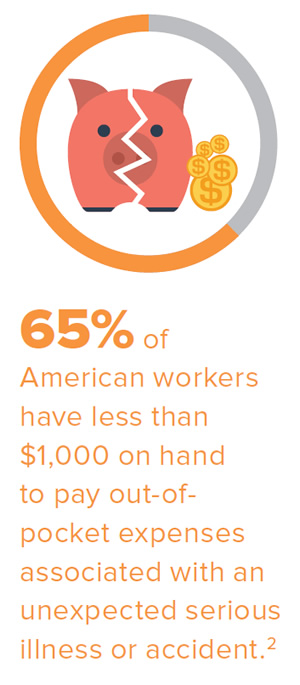 The need for disability insurance protection is crucial, particularly among primary wage-earners. According to the 2017 Aflac WorkForces Report, 65 percent of American workers have less than $1,000 on hand to pay out-of-pocket expenses associated with an unexpected serious illness or accident.2
Employers should consider adding employee-paid short-term disability coverage to their benefits options because by doing so they’ll help give their workers increased peace of mind. Disability insurance can help protect workers from financial difficulties with:
 Although many workers assume they are protected by employer-paid disability coverage, a growing number of companies have cut back on the benefits they offer. A decade ago, it was commonplace for a company’s internal disability plan to pay an employee 70 percent of income if disabled, but today the median salary replacement rate for short-term disability plans is 60 percent of annual earnings.3
Furthermore, many people assume they will receive benefits from Social Security or workers’ compensation. However, that is often not the case. Between 2005 and 2014, the percentage of applicants awarded Social Security benefits at the initial claims level averaged 23 percent.4 What’s more, the average monthly Social Security benefit paid to disabled Americans in 2017 was only $1,172.1
 As for depending on workers’ compensation to cover a disabling injury or illness, employees should consider that 95 percent of disabling accidents and illnesses are not work related, meaning workers’ compensation doesn’t cover them.5
The bottom line is that weathering an economic recession has opened Americans’ eyes to the value of voluntary short-term disability insurance.
Companies and their employees are recognizing the financial vulnerability that comes from being unprotected and underinsured. Neglecting to secure disability insurance is a prime example of how saving a few dollars in the short term can cost thousands in the long run.
This article is for informational purposes only and is not intended to be a solicitation.
1U.S. Social Security Administration, “Social Security Fact Sheet,” accessed Sep. 25, 2017 – https://www.ssa.gov/news/press/factsheets/basicfact-alt.pdf..
2The 2017 Aflac WorkForces Report is the seventh annual study examining benefits trends and attitudes. The study’s surveys, conducted by Lightspeed, captured responses from 1,800 benefits decision-makers and 5,000 employees across the United States in various industries. For more information, visitwww.AflacWorkForcesReport.com.
3Bureau of Labor Statistics, “Disability insurance plans: trends in employee access and employer costs,” accessed Sep. 25, 2017 - http://www.bls.gov/opub/btn/volume-4/disability-insurance-plans.htm#_edn6.
4U.S. Social Security Administration, “Annual statistical report on the social security disability insurance program 2015,” accessed Sep. 25, 2017 - https://www.ssa.gov/policy/docs/statcomps/di_asr/2015/di_asr15.pdf.
5LifeHealthPro, “The ethical considerations of selling disability insurance,” accessed Sep. 25, 2017 - http://www.lifehealthpro.com/2015/05/06/the-ethical-considerations-of-selling-disability-i.
In Idaho, Policy A57600IDR. In Oklahoma, Policies A57600OK and A57600LBOK. In Virginia, Policies A57600VA and A57600LBVA.This is a brief product overview only. Coverage may not be available in all states. Benefits/premium rates may vary based on plan selected. Optional riders are available at an additional cost. The policy has limitations and exclusions that may affect benefits payable. Refer to the policy for complete details, limitations, and exclusions.
Coverage is underwritten by American Family Life Assurance Company of Columbus. In New York, coverage is underwritten by American Family Life Assurance Company of New York.
Z171463
EXP 10/18







 New messages from Aflac |