

 New messages from Aflac |
Individuals & Families
Request a Quote
Choosing the right life insurance policy is important, and understanding the difference between term vs. whole life insurance is a major part of the decision. At Aflac, we offer a variety of life insurance plans for individuals and families, including term and whole life policies to help meet your specific needs. The key differences between term and whole life insurance come down to how long coverage lasts and whether your policy builds cash value. This guide breaks down both options so you can choose the right policy for your family with confidence.
Table of Contents
Term life insurance is a temporary policy that provides coverage for a set term or specific amount of time. Here are some key features to keep in mind about this type of policy:
Aflac offers term life insurance for individuals that you can purchase directly. Choose the term length that best works for you based on your unique situation.
Whole life insurance is a permanent policy that provides coverage for your entire life, as long as premiums are paid. Here are a few key features of this type of coverage:
Aflac offers whole life insurance for individuals that may give you peace of mind knowing your loved ones can receive financial protection no matter when you pass away. You can purchase a policy directly through Aflac.
The core difference between term and whole life insurance is that term coverage is temporary while whole life coverage is permanent. Whole life also builds cash value; term doesn’t.
Here’s a side-by-side look at the key differences:
| Term Life | Whole Life | |
|---|---|---|
| Coverage length | 10 – 30 years | Your entire lifetime |
| Premiums | Generally lower | Generally higher |
| Cash value | None | Builds over time |
| Death benefit | Paid if you pass during the term | Guaranteed, subject to policy terms |
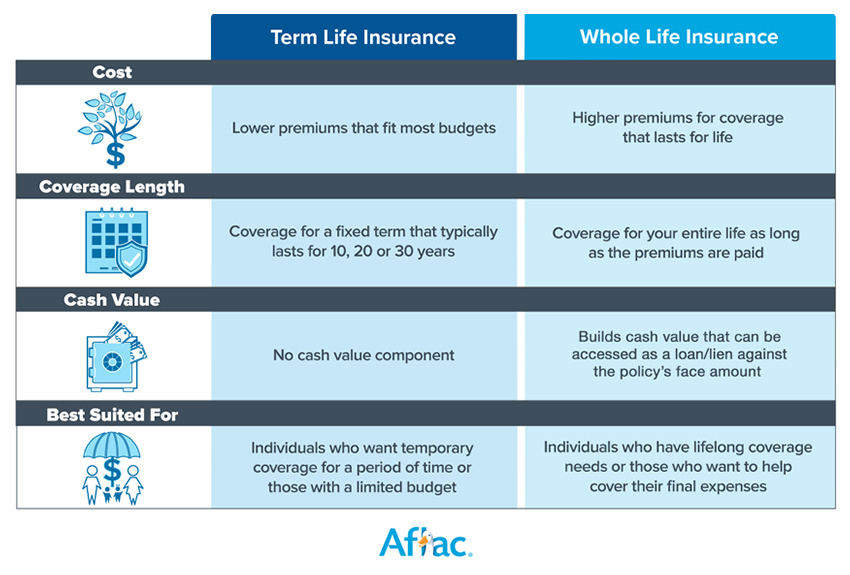
Whole life premiums are generally much higher than term premiums for the same coverage amount. The trade-off is that a portion of every whole life premium goes toward building cash value, while term premiums cover only the death benefit.
The costs of either plan vary depending on age, gender and medical history. Term life is typically more affordable in the short term. If your primary goal is to protect your family’s finances during a specific period — such as while a mortgage is outstanding or while children are growing up — term coverage may deliver the most value per dollar.
Whole life, on the other hand, builds cash value in a structured and predictable way, which may suit those who prefer simplicity or want a built-in savings component alongside lifelong protection. It’s more expensive, but it could provide more financial security in the long run.

Don’t wait until it’s too late. Help cover yourself and your family with coverage from Aflac.
Get StartedWhen deciding whether to get term or whole life insurance, it’s important to consider several factors:
Ultimately, the type of policy you choose should depend on your individual needs and financial circumstances. Consider discussing all your options with a qualified professional who can help you find the right kind of policy for you.
When a 20-year term life insurance policy ends, the coverage expires and your beneficiaries are no longer eligible for a payout. You may be able to renew coverage or apply for a new policy, though premiums will likely be higher because you’re older. Some term life insurance policies include a conversion rider that may allow you to switch to a permanent policy without a new health exam.
Standard term life insurance doesn’t build cash value, so you typically don’t receive money back when the term ends. The exception is a “return of premium” rider, which refunds some or all of your premiums if you outlive the term. These riders tend to come with higher premiums, which may offset the primary cost advantage of term coverage.
Neither policy is universally better — the right choice depends on your budget, timeline and financial goals. Term life tends to cost less and may suit those who need coverage for a specific period, while whole life provides permanent protection and a cash value component that may be useful for long-term planning.

Looking into getting a term life insurance policy? Find out what term life insurance is and its features, rates, and benefits.

Looking into getting a whole life insurance plan? Find out how whole life insurance works and the benefits, costs, pros, and cons.
Looking into getting a term life insurance policy? Find out what term life insurance is and its features, rates, and benefits.
Looking into getting a whole life insurance plan? Find out how whole life insurance works and the benefits, costs, pros, and cons.
1 LIMRA - 2025 Life Insurance Fact Sheet. Published July 26, 2025. https://www.limra.com/siteassets/newsroom/liam/2025/2025_facts_about_life_insurance.pdf. Accessed December 8, 2025.
Content within this article is provided for general informational purposes and is not provided as tax, legal, health, or financial advice for any person or for any specific situation. Employers, employees, and other individuals should contact their own advisers about their situations. For complete details, including availability and costs of Aflac insurance, please contact your local Aflac agent.
Coverage is underwritten by American Family Life Assurance Company of Columbus. In New York, coverage is underwritten by American Family Life Assurance Company of New York.
Aflac life policies - Term & Whole Life (B60000 series): In Arkansas, Oklahoma, Pennsylvania, Texas & Virginia, Policies: ICC18B60C10, ICC18B60100, ICC18B60200, ICC18B60300, & ICC18B60400. Not available in AK, CA, DC, DE, GU, HI, IA, ID, ME, ND, NE, NH, NM, NY, OR, PR, RI, SD, UT, VI or VT. Group Whole Life (Q60000 series): In Arkansas, Delaware & Oregon, Policy Q60100M. In Idaho Policy Q60100MID. In Oklahoma, Policy Q60100MOK. In Pennsylvania, Policy Q60100MPA. In Texas, Policy Q60100MTX. Not available in CA, KS, MA, NY or VA. Group Term Life (Q60000 series): In Arkansas, Idaho, Oklahoma, Oregon & Texas, Policy ICC18Q60200M. In Delaware, Policy Q60200M. Not available in CA, KS, MA, NY or VA.
Aflac Final Expense insurance coverage is underwritten by Tier One Insurance Company, a subsidiary of Aflac Incorporated and is administered by Aetna Life Insurance Company. Tier One Insurance Company is part of the Aflac family of insurers. In California, Tier One Insurance Company does business as Tier One Life Insurance Company (Tier One NAIC 92908). Not available in New York.
Final Expense Life - In Arkansas, Delaware, Idaho, Oklahoma, Oregon, Pennsylvania, Texas, & Virginia, Policies ICC21-AFLLBL21 and ICC21-AFLRPL21; and Riders ICC21-AFLABR22, ICC21-AFLADB22, and ICC21-AFLCDR22. Not available in NY.
Content within this article is provided for general informational purposes and is not provided as tax, legal, health, or financial advice for any person or for any specific situation. Employers, employees, and other individuals should contact their own advisers about their situations. For complete details, including availability and costs of Aflac insurance, please contact your local Aflac agent.
Coverage may not be available in all states. Benefits/premium rates may vary based on state and plan levels. Optional riders may be available at an additional cost. Policies and riders may also contain a waiting period. Refer to the exact policy and rider forms for benefit details, definitions, limitations and exclusions.
Receipt of accelerated death benefits may affect eligibility for public assistance programs. Benefits may also be taxable and are not expected to receive the same favorable tax treatment as other types of accelerated death benefits that may be available.
Aflac | Tier One | WWHQ | 1932 Wynnton Road | Columbus, GA 31999
Aflac New York | 22 Corporate Woods Boulevard, Suite 2 | Albany, NY 12211
Z2200994R3
EXP 1/27